16
IMDb’s Weighted Rating Formula: The Math Behind Movie Scores

Ever wonder why a movie with 10,000 five-star ratings and one two-star rating might still have a 7.8 score, while a film with 500 perfect scores sits at 8.1? It’s not a glitch. It’s math. IMDb doesn’t just average ratings. It uses a weighted formula designed to filter out noise, bias, and manipulation. Understanding this formula helps you see past the surface number and into what the rating really means.
How IMDb’s Rating System Works
IMDb’s rating isn’t a simple average. If it were, every blockbuster with a cult following or a controversial release would skew wildly. Instead, it uses a weighted rating formula borrowed from statistical methods used in e-commerce and recommendation systems. This approach gives more weight to movies with a larger number of votes, making the score more reliable.
The formula looks like this:
WR = (v / (v + m)) × R + (m / (v + m)) × C
Let’s break it down:
- WR = Weighted Rating (the score you see)
- R = Average rating for the movie (mean of all user votes)
- v = Number of votes for the movie
- m = Minimum votes required to be listed in the top ratings (currently 25,000)
- C = Mean vote across the entire IMDb database (around 7.0 as of 2026)
Here’s what this means in practice. If a movie has fewer than 25,000 votes, its score gets pulled toward the overall IMDb average (C). The fewer votes it has, the more it’s influenced by C. Once a movie hits 25,000 votes, the formula gives full weight to its own average (R). Beyond that, more votes only strengthen its position - they don’t change the formula’s behavior.
Why Minimum Votes Matter
Why 25,000? Because IMDb wants to avoid letting small groups of highly motivated users - whether superfans, trolls, or bots - distort the score. A movie with 50 votes that gets a perfect 10.0 might be a hidden gem… or a manipulated outlier. Without a threshold, that 10.0 would sit above The Shawshank Redemption - which has over 2.3 million votes and a 9.3.
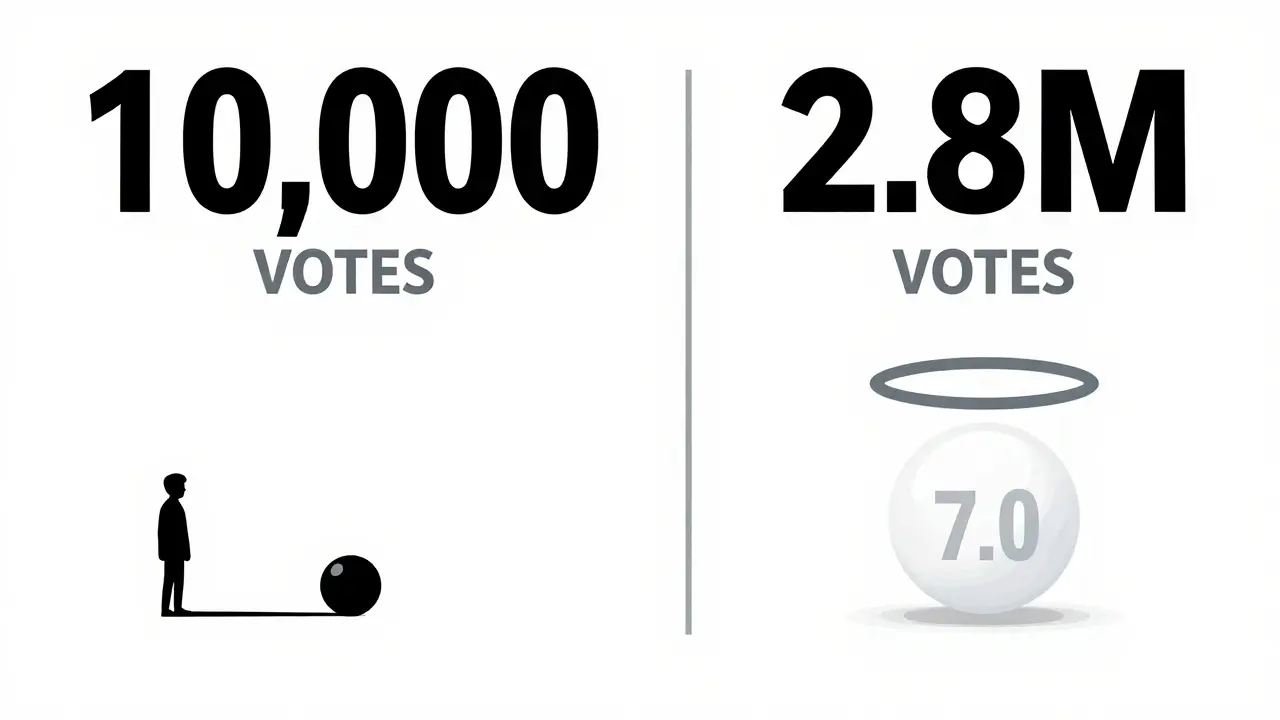
Take The Dark Knight (2008). It has over 2.8 million votes and an average rating of 9.0. Its weighted rating is almost identical to its actual average because it far exceeds the 25,000-vote threshold. But a new indie film with 5,000 votes and a 9.2 average? Its weighted rating might be 8.4 - not because people didn’t love it, but because there aren’t enough votes yet to trust that score fully.
This is why you’ll often see new releases with fluctuating scores. Early ratings are noisy. By the time a movie hits 10,000 votes, the score starts to stabilize. At 25,000, it’s locked in.
The Role of the Global Average (C)
That 7.0 number - the global average - isn’t arbitrary. It’s calculated daily from all movies on IMDb with at least one vote. It acts as a baseline. Think of it like a gravity well. Movies with few votes get pulled toward it. The more votes they gather, the more they escape its pull.
This prevents the top charts from being dominated by niche films with tiny, enthusiastic fanbases. It also protects against vote brigading. If a group of users tries to inflate a movie’s score by voting en masse, the formula dampens their impact unless they reach the 25,000-vote threshold - which is hard to do without real audience traction.
For example, a movie with 10,000 votes and a 9.5 average might have a weighted rating of 8.7. That’s because:
- v = 10,000
- m = 25,000
- R = 9.5
- C = 7.0
Plugging in:
WR = (10,000 / 35,000) × 9.5 + (25,000 / 35,000) × 7.0
WR = 0.2857 × 9.5 + 0.7143 × 7.0
WR = 2.714 + 5.000 = 7.714
Wait - that’s 7.7? But the average was 9.5? Exactly. The formula corrects for the small sample size. Without it, the movie would look like a perfect 10, which wouldn’t reflect its true reach.
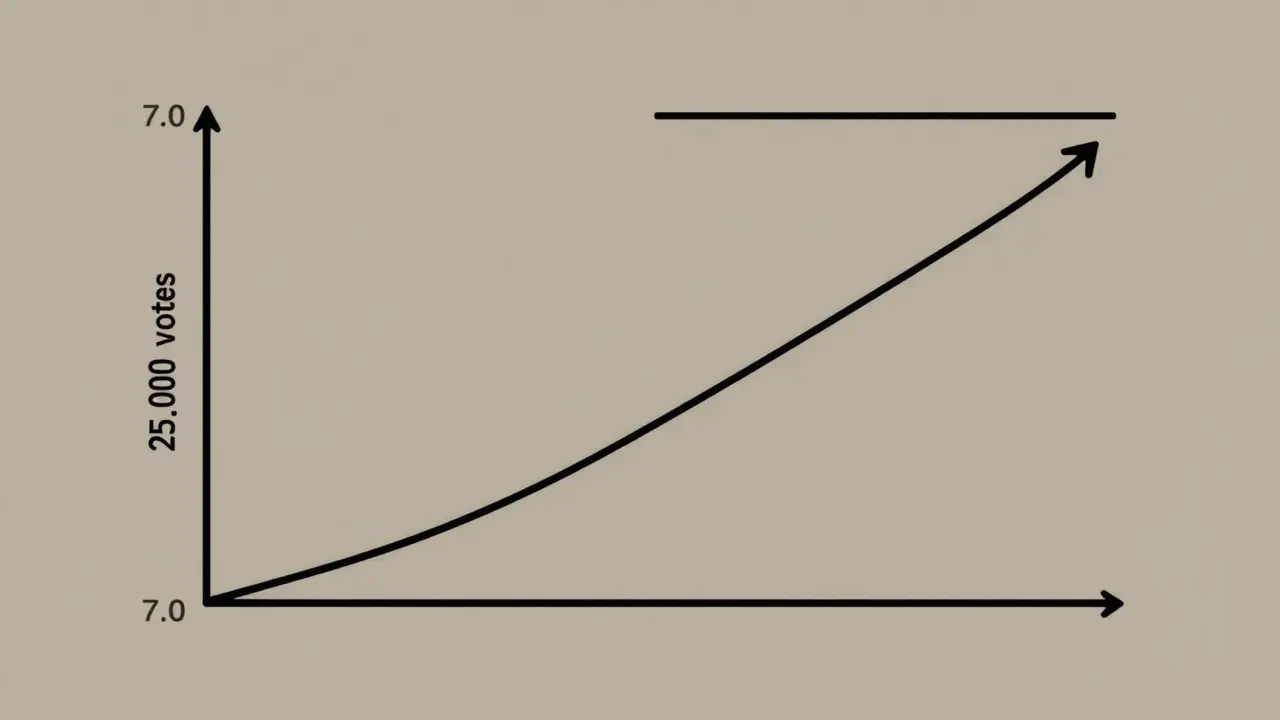
What Happens When a Movie Hits 25,000 Votes?
That’s the tipping point. Once a movie crosses it, the weighted rating becomes almost identical to the actual average. The influence of C drops to near zero. From there, every new vote matters more.
Consider Parasite (2019). Before it hit 25,000 votes, its score hovered around 8.1. As votes piled up - thanks to awards buzz and word-of-mouth - its weighted rating climbed steadily. By the time it hit 100,000 votes, it was at 8.4. At 1.2 million votes, it sits at 8.4. The score barely budged because the average rating was already stable.
That’s the beauty of the system. It doesn’t chase trends. It captures consensus.
How This Affects You as a Viewer
If you’re trying to decide what to watch, don’t just look at the number. Look at the number of votes. A movie with a 7.8 and 500,000 votes is more trustworthy than one with a 9.0 and 1,200 votes.
Here’s a rule of thumb:
- Under 5,000 votes: Treat the score as a hint, not a verdict.
- 5,000-20,000 votes: The score is starting to stabilize.
- 20,000-25,000 votes: Watch for the jump - it’s coming.
- Over 25,000 votes: The score is reliable.
- Over 100,000 votes: This is cultural consensus.
Also, check the distribution. A movie with 40% five-star ratings and 30% one-star ratings might have a 7.0 average - but that’s polarizing. A movie with 60% five-star and 20% four-star ratings is more consistently loved. IMDb doesn’t show you this breakdown on the main page, but you can find it by clicking into the ratings graph.
Common Misconceptions
People often think IMDb ratings are manipulated. They’re not - not by design. The formula is public, transparent, and unchanged for over a decade. What changes is the data.
Some believe that older movies have an advantage because they’ve had more time to accumulate votes. That’s true. But it’s also fair. A movie that’s stood the test of time has earned its vote count.
Others think that critics’ scores (like Rotten Tomatoes) are more accurate. They’re not the same thing. Rotten Tomatoes measures approval percentage. IMDb measures user sentiment on a 1-10 scale. One tells you how many liked it. The other tells you how much they liked it.
And no, IMDb doesn’t remove fake votes. It doesn’t need to. The formula neutralizes them. A bot army of 10,000 votes won’t move the needle. You’d need 25,000 real, diverse votes to make a difference - and that’s nearly impossible without genuine audience engagement.
What This Tells Us About Film Culture
The IMDb formula isn’t just math - it’s a reflection of how audiences engage with movies. It rewards longevity, broad appeal, and sustained conversation. A film that sparks debate, gets rediscovered, or gains new fans years later can climb slowly but surely. It doesn’t need a viral moment. It just needs time.
That’s why It’s a Wonderful Life (1946) still sits at 8.1 despite being a black-and-white Christmas film from the 1940s. People keep watching it. People keep voting. And the formula keeps listening.
It’s not perfect. It doesn’t capture nuances like cultural context, genre bias, or regional preferences. But for a database with over 200 million users, it’s the best system we have.
Why doesn’t IMDb just use a simple average?
A simple average would let small groups of voters - like fans of a niche film or trolls trying to manipulate scores - skew results dramatically. IMDb’s weighted formula ensures only movies with enough votes from a broad audience get to compete in the top rankings. This prevents outliers from dominating the chart.
Can a movie’s rating drop after more people rate it?
Yes. If a movie has a high average but low vote count, its weighted rating is pulled toward the global average (C). When more people vote - especially if they give lower scores - the actual average can drop, and the weighted rating adjusts accordingly. For example, a film with 1,000 votes averaging 9.5 might start at 8.3. After 50,000 votes, if the average dips to 8.7, the score drops from 8.3 to 8.6. That’s the system working as intended.
Is the 25,000-vote threshold the same for all movies?
Yes. The threshold (m) is fixed at 25,000 for all titles on IMDb, regardless of genre, country, or release year. This ensures consistency. A documentary and a Hollywood blockbuster are judged by the same standard. The difference is in how many people choose to vote - not how the system treats them.
Why does IMDb use 7.0 as the global average?
The global average (C) is calculated daily from all movies on IMDb with at least one vote. It’s not fixed at 7.0 - it fluctuates slightly. In 2026, it’s around 7.0 because users tend to rate above average (most people don’t rate bad movies). If users started giving more 3s and 4s, C would drop. The system adapts to real behavior, not assumptions.
Do critics’ scores affect IMDb ratings?
No. IMDb ratings come only from registered users who vote on the site. Critics’ reviews - whether from Roger Ebert, Rotten Tomatoes, or Metacritic - have no influence on the IMDb score. The two systems operate independently. IMDb measures audience sentiment; critics measure professional opinion.