3
The Searchers Review: Why John Ford’s 1956 Masterpiece Still Haunts Us

Have you ever watched a movie where the hero is actually the villain? That is the uncomfortable truth sitting at the heart of The Searchers is a 1956 American epic western film directed by John Ford, starring John Wayne as the obsessed hunter Ethan Edwards. Released in 1956, this film didn't just define the Western genre; it broke it open to reveal the dark psychology underneath. It isn't just about riding horses across the desert. It is a story about racism, obsession, and the cost of vengeance that feels surprisingly modern today.
Key Takeaways
- The Searchers redefined the Western hero by making him flawed, racist, and deeply damaged rather than purely noble.
- John Wayne’s performance as Ethan Edwards is widely considered his best work, showcasing a complexity rarely seen in his previous roles.
- The film’s visual language, including the famous doorframe composition, has influenced directors like George Lucas and Martin Scorsese for decades.
- Critics debate the film’s legacy regarding its portrayal of Native Americans, balancing artistic merit with problematic stereotypes.
- Understanding The Searchers requires looking past the action to see the psychological tragedy of a man who destroys everything he tries to save.
The Obsession of Ethan Edwards
Most Westerns give you a clear good guy and a bad guy. Ethan Edwards is the protagonist of The Searchers, played by John Wayne. He starts the movie returning from the Civil War, bitter and broken. His family is killed, and his adopted sister, Debbie, is taken by Comanche warriors. Instead of moving on, Ethan decides to spend years hunting them down. But here is the twist: he doesn’t want to rescue Debbie anymore. He wants to kill her because she has been "tainted" by living with the Comanches. This makes him an anti-hero long before the term became popular.
John Wayne brings a terrifying intensity to the role. You can see the hate in his eyes. It isn’t the heroic glare we usually associate with him. It is cold, calculating, and deeply unsettling. When he finally finds Debbie, he stands over her with a gun, ready to shoot her. The tension in that scene is palpable. He struggles between his love for her and his twisted sense of justice. In the end, he chooses to save her, but the damage is done. He leaves the family home alone, walking into the wilderness. He is too broken to fit back into society. This ending was radical for 1956. Heroes were supposed to get the girl and ride off into the sunset together. Ethan gets neither.
Visual Storytelling and Cinematography
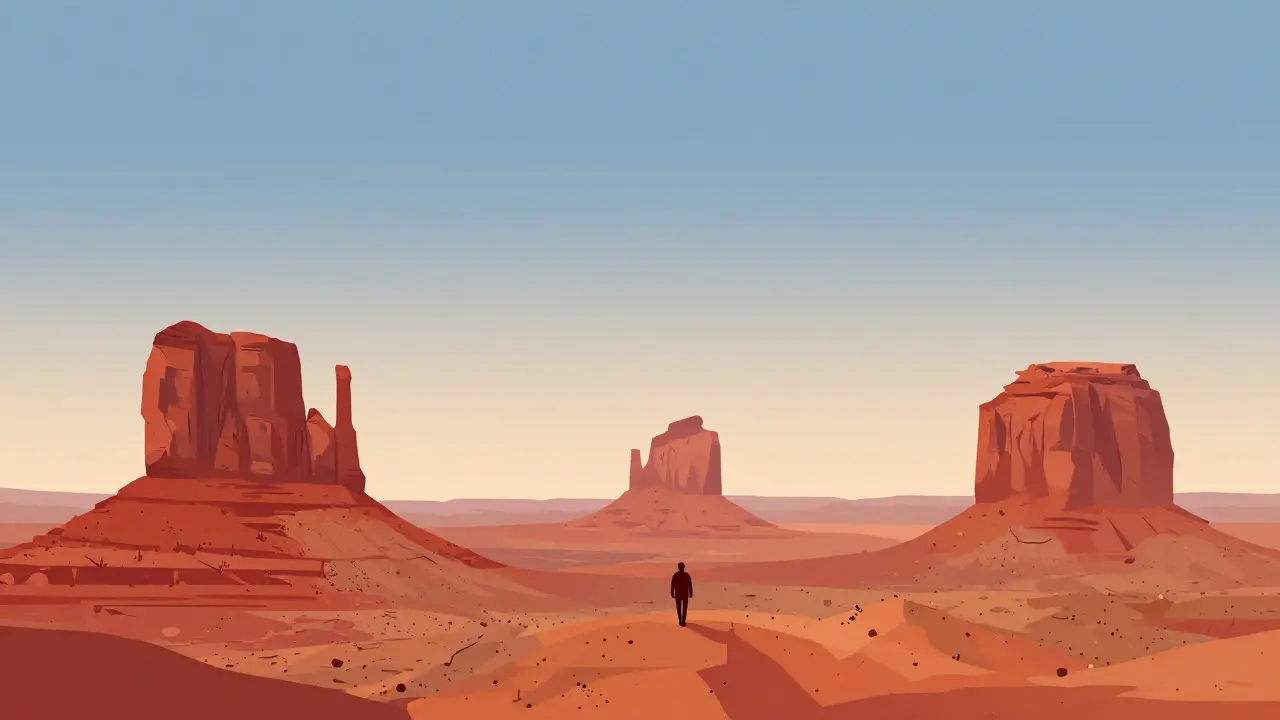
You don’t need dialogue to understand the emotions in The Searchers. Director John Ford is an influential American film director known for his Westerns uses the landscape itself as a character. The vast deserts, towering mountains, and wide-open skies make the humans look small and insignificant. This visual scale emphasizes Ethan’s isolation. He is tiny against the backdrop of nature, which mirrors his internal emptiness.
One of the most famous shots in cinema history comes from this film. It is called the "doorframe shot." Throughout the movie, characters are framed within the wooden doorframes of the Edwards house. At the beginning, Ethan stands outside the frame, excluded from the family. By the end, after saving Debbie, he walks out through the doorframe and disappears into the darkness. This simple visual trick tells us everything we need to know about his journey. He never truly belongs inside. He is always an outsider, even among his own people.
The cinematographer, Winton C. Hoch is the Academy Award-winning cinematographer for The Searchers, used Technicolor to create stunning images. The colors are vibrant but often harsh. The reds of the sunsets and the blues of the twilight sky add emotional weight to every scene. These visuals weren’t just pretty pictures; they were designed to reflect the mood of the characters. When Ethan is angry, the lighting becomes stark and shadowy. When there is hope, the light softens. This attention to detail helps explain why the film remains visually relevant nearly seventy years later.
Racism and Controversial Themes
We cannot talk about The Searchers without addressing its biggest flaw. The film portrays Native Americans, specifically the Comanche tribe, as savage enemies. They are shown stealing children, killing families, and speaking in guttural sounds rather than clear dialogue. For many viewers, especially Indigenous audiences, these depictions are harmful and inaccurate. They reinforce stereotypes that have caused real-world prejudice for generations.
However, some critics argue that the film is actually criticizing racism. Ethan Edwards is explicitly racist. He hates Comanches not just because they killed his family, but because of their race. He says things like, "I’ve got a mind to cut her throat myself." The movie shows us how toxic this hatred is. It eats him alive. It isolates him from his friends and family. By making the racist character the protagonist, Ford forces the audience to confront their own biases. Are we rooting for Ethan despite his racism, or because we share it? It is an uncomfortable question that the film refuses to answer easily.
This duality creates a complicated legacy. On one hand, it is a masterpiece of filmmaking. On the other hand, it perpetuates damaging myths about Native peoples. Modern viewers must navigate this tension. We can appreciate the art while acknowledging the harm. Ignoring the racism would be dishonest. But dismissing the entire film because of it ignores the deeper critique Ford embedded in the story. Ethan’s racism is part of his tragedy. It is what makes him dangerous and ultimately alone.
Influence on Modern Cinema
If you watch modern blockbusters, you will see the fingerprints of The Searchers everywhere. Directors like George Lucas have cited it as a major influence on Star Wars. Think about Luke Skywalker searching for his father, or the lone hero wandering the galaxy. Those narratives stem directly from Ethan’s quest. Even Martin Scorsese, known for gritty urban dramas, admires Ford’s ability to tell stories through visuals rather than words.
The concept of the "lone wanderer" owes much to this film. Before The Searchers, Western heroes were often community members who protected towns. Afterward, the hero became someone who couldn’t stay put. Someone haunted by the past. You see this archetype in countless TV shows and movies today. From Bonanza to Fargo, the idea of a damaged individual seeking redemption or revenge is central to storytelling. Ford helped create this template.
Even recent adaptations pay homage to the original. The 2014 TV series Search Party borrows the title and theme of searching for lost loved ones, though in a completely different setting. While not a direct remake, it shows how enduring the core premise is. People are fascinated by the idea of going to great lengths to find someone. Whether it is a kidnapped child or a missing friend, the emotional drive is similar. The Searchers tapped into that universal human experience.
| Element | Traditional Western Hero | Ethan Edwards (The Searchers) |
|---|---|---|
| Motivation | Justice, Community Protection | Vengeance, Personal Obsession |
| Relationship with Society | Integrated, Respected Member | Outcast, Alienated |
| View on Native Americans | Often Simplified "Enemy" | Explicitly Racist Hatred |
| Ending | Happy Resolution, Marriage | Tragic Isolation, No Closure |
| Role of Landscape | Background Setting | Active Character Symbolizing Emotion |
Why It Still Matters Today
In 2026, we live in a world still grappling with issues of race, identity, and trauma. The Searchers offers a mirror to our current struggles. It asks us to examine why we hold onto grudges. It challenges us to recognize when our search for justice turns into cruelty. These questions are timeless. They apply to political conflicts, personal relationships, and social movements alike.
The film also reminds us of the power of cinema to provoke thought. It doesn’t provide easy answers. It presents a messy, painful reality and lets the audience sit with it. That takes courage from both the filmmakers and the viewers. Not every movie dares to be this honest. Many prefer comfort over truth. The Searchers chooses truth, even when it hurts.
For students of film, it is a masterclass in direction. Every frame is deliberate. Every color choice matters. Every line of dialogue serves a purpose. Studying this film teaches you how to communicate complex ideas without relying on exposition. It shows that silence can speak louder than words. And that a single image can carry more meaning than pages of script.
How to Watch The Searchers Now
If you haven’t seen The Searchers, where do you start? First, find a high-quality restoration. The picture quality makes a huge difference. Look for Blu-ray releases or streaming options that preserve the original Technicolor vibrancy. Watching it on a small phone screen does it no justice. You need to see the vast landscapes to feel the impact.
Second, watch it with an open mind. Be prepared to feel uncomfortable. Don’t expect a typical adventure story. Expect a psychological drama wrapped in Western clothing. Pay attention to John Wayne’s facial expressions. Notice how the camera frames the characters. Listen to the music by Dimitri Tiomkin is the composer of the iconic score for The Searchers, which adds layers of melancholy to the action.
Finally, discuss it afterward. Talk to friends or read reviews online. Share your thoughts on the racism themes. Debate whether Ethan is redeemable. Engage with the material critically. The more you analyze it, the richer the experience becomes. It is not a movie you watch once and forget. It lingers in your mind, demanding reflection.
Is The Searchers appropriate for young viewers?
Not without guidance. The film contains intense violence, racial slurs, and disturbing themes of kidnapping and sexual assault. Parents should consider the maturity level of their children. It is best suited for teenagers and adults who can handle complex moral dilemmas and historical context.
Who plays Martha Edwards in The Searchers?
Martha Edwards, Ethan’s sister-in-law, is played by Natalie Wood is an actress who played the younger version of Deborah Edwards in flashbacks. She appears primarily in flashback sequences, showing the happy family life before the attack. Her presence contrasts sharply with the bleak present day.
What is the significance of the doorframe shots?
The doorframe shots symbolize inclusion and exclusion. Characters inside the frame belong to the family unit. Ethan, standing outside, is an outsider. As the film progresses, the framing shifts to reflect changing relationships. It is a subtle visual cue that reinforces the theme of alienation.
Did John Wayne enjoy playing Ethan Edwards?
Yes, Wayne considered it one of his favorite roles. He appreciated the depth and complexity of the character. Unlike his usual heroic parts, Ethan allowed him to explore darker emotions. Wayne reportedly studied the character extensively to portray his bitterness convincingly.
Where was The Searchers filmed?
Principal photography took place at Rancho del Cielo is John Ford's private ranch in Carmel Valley, California and Monument Valley, Utah. Monument Valley provided the iconic sweeping vistas that define the film’s visual style. The location shooting added authenticity to the Western setting.
How long does it take to complete the search in the film?
The search spans nine years. The film begins in 1868 and ends in 1877. This extended timeline highlights Ethan’s obsessive dedication. Most people would have given up after a few months. His persistence underscores his mental instability and unwavering focus on revenge.
Is there a sequel to The Searchers?
No, there is no official sequel. However, several films have drawn inspiration from it. For example, The Man Who Shot Liberty Valance shares thematic similarities with The Searchers, exploring the myth versus reality of the Old West. Both films were directed by John Ford and star John Wayne.