7
Desert Epics and Action Landscapes: How Lawrence to Dune Shaped Cinema

There is a specific kind of cinema that makes you feel small. Not the smallness of being ignored, but the smallness of standing on a cliff edge, looking out at an ocean of sand that stretches beyond the horizon. These are desert epics. They are not just movies set in hot places; they are stories where the landscape itself is the main character. From the black-and-white grit of Lawrence of Arabia, released in 1962, to the sprawling, technologically advanced vistas of Denis Villeneuve’s Dune series, these films share a DNA that goes deeper than just costumes and camels.
We often think of action as explosions and gunfights. But in the genre of desert epics, the action is often about survival against nature. It is about the sheer physical toll of moving across a terrain that wants to kill you. This article breaks down how filmmakers use heat, light, and silence to create some of the most memorable action sequences in history. We will look at the technical choices, the storytelling tricks, and the cultural impact of these massive productions.
The Architecture of Heat and Light
When you watch a desert epic, you can almost feel the temperature rising through the screen. This is not an accident. Directors and cinematographers spend months planning how to capture the oppressive nature of the environment. In Lawrence of Arabiadirected by David Lean, the cinematographer Freddie Young used large-format cameras (65mm) to capture every grain of sand with terrifying clarity. The result was a visual style that felt documentary-like yet mythic.
Compare this to Dune (2021). Here, the goal was different. The director wanted the audience to feel the weight of the planet Arrakis. He achieved this by controlling the light. Notice how the shadows are deep and sharp? This contrast creates a sense of danger. The sun isn't just lighting the scene; it is a threat. Every time a character steps into the open without protection, you tense up. You know what happens next. This technique turns the environment into an active antagonist.
- High Contrast Lighting: Used to emphasize the harshness of the sun and the depth of the dunes.
- Wide Aspect Ratios: Both films use ultra-wide screens (like IMAX or Super Panavision 70) to show the emptiness surrounding the characters.
- Natural Sound Design: The wind, the shifting sand, and the distant thunder are louder than dialogue in many scenes.
This approach to "action landscapes" means that the camera doesn't just follow the hero. It watches the hero struggle against the world. The landscape dictates the pacing. When the heat is too intense, the movie slows down. When the storm comes, the editing becomes chaotic. The environment controls the rhythm of the film.
Movement as Storytelling
In traditional action movies, movement is usually fast and linear. A car chase goes from point A to point B. In desert epics, movement is circular, exhausting, and often pointless. Think about the opening sequence of Lawrence of Arabia. We see a match flare up, then pull back to reveal a vast, empty desert. Then we see a figure walking. Then we see more walking. For minutes, there is no plot. There is only the act of crossing the desert.
Why do this? Because it establishes stakes. By showing us how hard it is to move across the sand, the later action scenes feel earned. When Lawrence finally rides into a city, it matters because we have seen his journey. In Dune, the movement is restricted by technology. The stillsuits-the water-recycling suits worn by the Fremen-are not just cool gadgets; they are narrative devices. They force characters to be careful. Every step must be deliberate. If you run recklessly, you lose water. If you lose water, you die.
This restriction creates a unique type of tension. It is not the adrenaline rush of a fistfight; it is the slow-burn anxiety of resource management. The audience understands that speed is dangerous. This flips the script on standard action tropes. Instead of "go faster," the rule is "go smarter." This makes the action scenes more intellectual and physically grounded.
| Element | Lawrence of Arabia (1962) | Dune (2021/2024) |
|---|---|---|
| Camera Format | Super Panavision 70 (Practical) | IMAX 15/70 & Digital Hybrid |
| Primary Threat | Nature & War | Nature & Political Intrigue |
| Mobility | Camels & Horses (Animal Power) | Ornithopters & Stillsuits (Tech/Aid) |
| Sound Strategy | Orchestral Swell & Silence | Bass-heavy Scores & Industrial Noise |

The Mythology of Isolation
Desert epics thrive on isolation. The characters are cut off from society, from help, and often from their own humanity. This isolation forces them to confront who they really are. In Lawrence of Arabia, the title character starts as a shy librarian and ends as a war hero and a madman. The desert strips away his social mask. There is no one left to impress. Only the sand remains.
In Dune, Paul Atreides faces a similar stripping away. He arrives on Arrakis expecting to be a noble leader. Instead, he becomes a survivor. The desert tests his beliefs, his religion, and his morality. The isolation allows for a psychological depth that is rare in other action genres. You don't just watch Paul fight enemies; you watch him fight his own destiny.
This theme resonates because we all face moments of isolation in life. Times when we have to rely solely on ourselves. Desert epics amplify this experience to a mythical scale. They ask the question: What happens to you when the world disappears? The answer is usually transformation. The desert does not break you; it refines you. Like gold in a fire, the impurities burn away, leaving only the essential self.
Silence as a Weapon
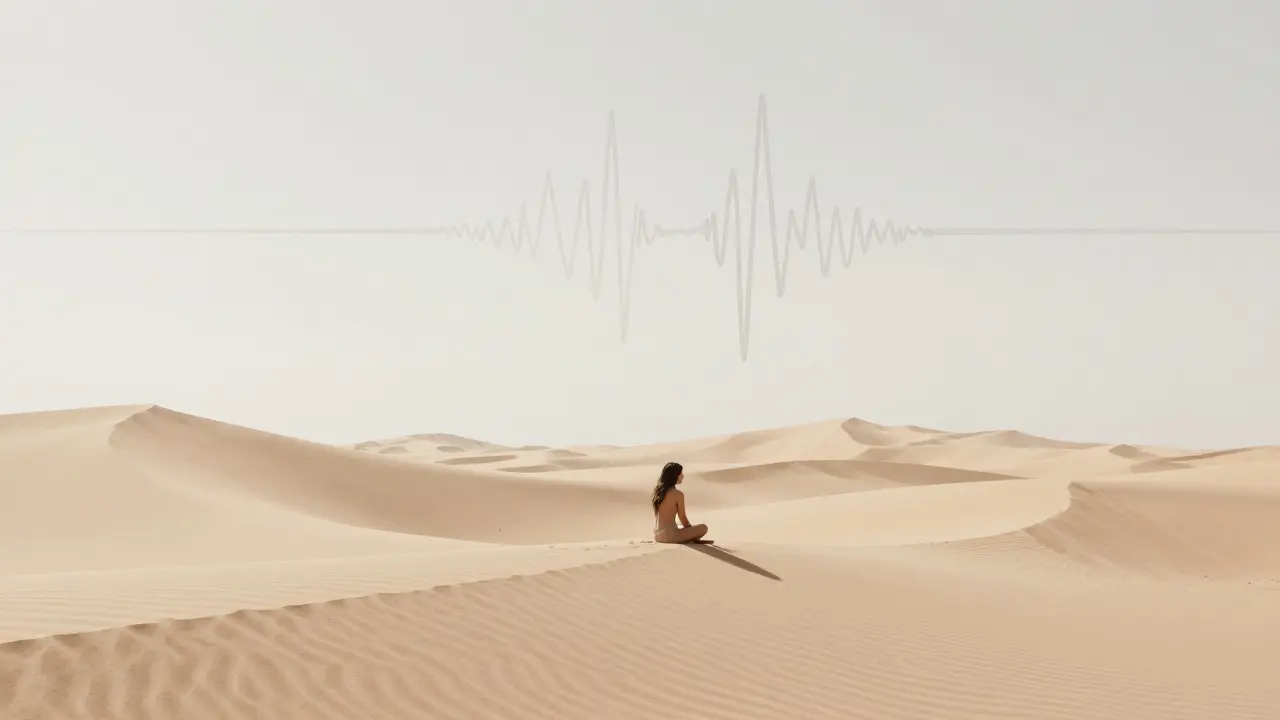
Most action movies are loud. Gunshots, engines, screams-they fill every second of audio space. Desert epics use silence differently. Silence is not empty; it is heavy. In both Lawrence of Arabia and Dune, there are long stretches where nothing is said. The only sound is the wind or the breathing of the characters.
This silence serves two purposes. First, it builds anticipation. When the noise finally comes-a sandworm emerging, a cavalry charge-it hits harder because of the quiet before it. Second, it emphasizes vulnerability. In a noisy city, you can hide. In a silent desert, every footstep echoes. You are exposed. This auditory technique makes the audience lean in. We become hyper-aware of the smallest sounds, mirroring the characters' heightened senses.
Composer Hans Zimmer’s score for Dune exemplifies this. He uses low-frequency drones and throat singing to create a soundscape that feels ancient and alien. It is not melodic in the traditional sense; it is atmospheric. It wraps around the viewer like the heat haze. Similarly, Maurice Jarre’s score for Lawrence of Arabia uses sweeping strings that mimic the endless horizons. Both scores tell us that we are in a place outside of normal time.
Modern Relevance of Old Tropes
You might wonder why we still care about desert epics in 2026. After all, we live in a digital age. We scroll through feeds, not dunes. Yet, the appeal remains strong. Perhaps it is because our modern lives are cluttered. We are constantly connected, constantly distracted. Desert epics offer a form of visual detox. They present a world that is simple, brutal, and honest.
Furthermore, the themes are more relevant than ever. Climate change has brought the concept of arid, uninhabitable lands into the global conversation. Films like Dune explore water scarcity, ecological collapse, and the struggle for resources. These are not just sci-fi problems; they are real-world issues. By watching these films, we engage with these anxieties in a safe, fictional space.
The action landscapes also reflect a desire for scale. In a world of micro-content and short attention spans, these epics demand your full attention. They require patience. They reward you for staying. In a way, watching a desert epic is an act of rebellion against the fast-paced nature of modern media. It says: I am willing to sit still. I am willing to look at the horizon.
Conclusion: The Endless Horizon
From the practical effects of the 1960s to the CGI-enhanced realism of today, desert epics have evolved, but their core mission remains the same. To make us feel the weight of the world. To show us that humans are small, but capable of great things. Whether it is T.E. Lawrence riding a camel or Paul Atreides facing a sandworm, the story is always about the individual against the infinite.
Next time you watch a film set in the desert, pay attention to the sand. Pay attention to the light. Listen to the silence. You will see that the landscape is not just a backdrop. It is the heart of the story. And that is why these epics endure. They remind us that even in the harshest conditions, life finds a way to move forward.
What makes a desert epic different from other action movies?
Desert epics prioritize the environment as a central character. Unlike urban action films where the setting is often neutral, desert epics use heat, isolation, and vast landscapes to create tension. The action is slower, more methodical, and focused on survival rather than just combat.
How did Lawrence of Arabia influence modern filmmaking?
It pioneered the use of large-format photography (65mm) to capture detailed, immersive landscapes. It also established the trope of the "long walk"-using extended shots of travel to build character and atmosphere before the main action begins.
Why is silence important in desert epics?
Silence emphasizes vulnerability and anticipation. In a vast, empty landscape, every sound stands out. This makes sudden noises, like enemy attacks or natural disasters, much more impactful and frightening for the audience.
What is the role of technology in Dune compared to Lawrence of Arabia?
In Lawrence of Arabia, technology is minimal (camels, horses, early firearms), emphasizing human endurance. In Dune, technology (stillsuits, ornithopters) is crucial for survival but also restricts movement, creating a different kind of tactical tension based on resource management.
Are desert epics only about war?
No. While war is often a plot device, the core theme is usually personal transformation and survival. The desert acts as a mirror, forcing characters to confront their true selves away from societal constraints.